Offshore Staffing Services for CFO Cost Control in 2026


Modern finance leaders face a difficult dual mandate: aggressively control operating expenses (OpEx) while preserving the company’s capacity to grow. Because human capital dominates corporate budgets, headcount naturally becomes the primary target during cost-cutting cycles.
However, traditional layoffs rarely deliver sustained savings. Instead, they tend to trigger high upfront expenses, such as severance packages and legal compliance friction, and often lead to a quiet reemergence of those exact same costs down the road. When companies downsize too quickly, they often end up overpaying for emergency local contractors or internal overtime just to keep daily operations running.
To avoid these downstream risks, forward-thinking organizations evaluate offshore staffing services as a strategy for scalable workforce management.
This guide explains how finance leaders can use offshore staffing strategically in 2026 through structured budgeting, productivity measurement, governance controls, and scalable workforce planning.
Why CFOs Are Re-Evaluating Labor Cost Structures
Labor remains the largest operating expense for most organizations, ranging 40% to 80% of the total OpEx. In industries such as SaaS, eCommerce, marketing services, customer support, and operations management, payroll costs continue to rise faster than revenue growth.
At the same time, organizations are facing:
- Longer recruitment timelines
- Increased competition for skilled professionals
- Higher benefit and infrastructure costs
- Expanding compliance obligations
- Pressure to improve EBITDA (earnings before interest, taxes, depreciation, and amortization) margins
As a result, many companies are shifting toward hybrid workforce models that combine local leadership with highly skilled offshore teams.
This approach allows organizations to pursue:
- Better headcount cost control
- Faster hiring timelines
- Increased operational flexibility
- Reduced infrastructure overhead
- More scalable workforce planning

What Are Offshore Staffing Services?
Offshore staffing services provide companies with dedicated remote professionals located in lower-cost global talent markets such as the Philippines.
Unlike traditional outsourcing models, modern offshore staffing focuses on embedding full-time professionals directly into a company’s workflows, reporting structure, and operational systems.
These professionals may support:
- Finance and accounting
- Marketing operations
- Customer support
- Data processing
- Executive assistance
- eCommerce operations
- Technical and operational functions
For CFOs, offshore staffing is most effective when integrated into broader CFO cost-management initiatives rather than treated as an isolated HR function.
How Offshore Staffing Supports Labor Cost Reduction
The primary financial advantage of offshore staffing is the ability to optimize total employment costs while maintaining operational output.
Companies leveraging offshore staffing often reduce labor expenses by 50–80%, depending on role complexity, geography, and organizational structure.
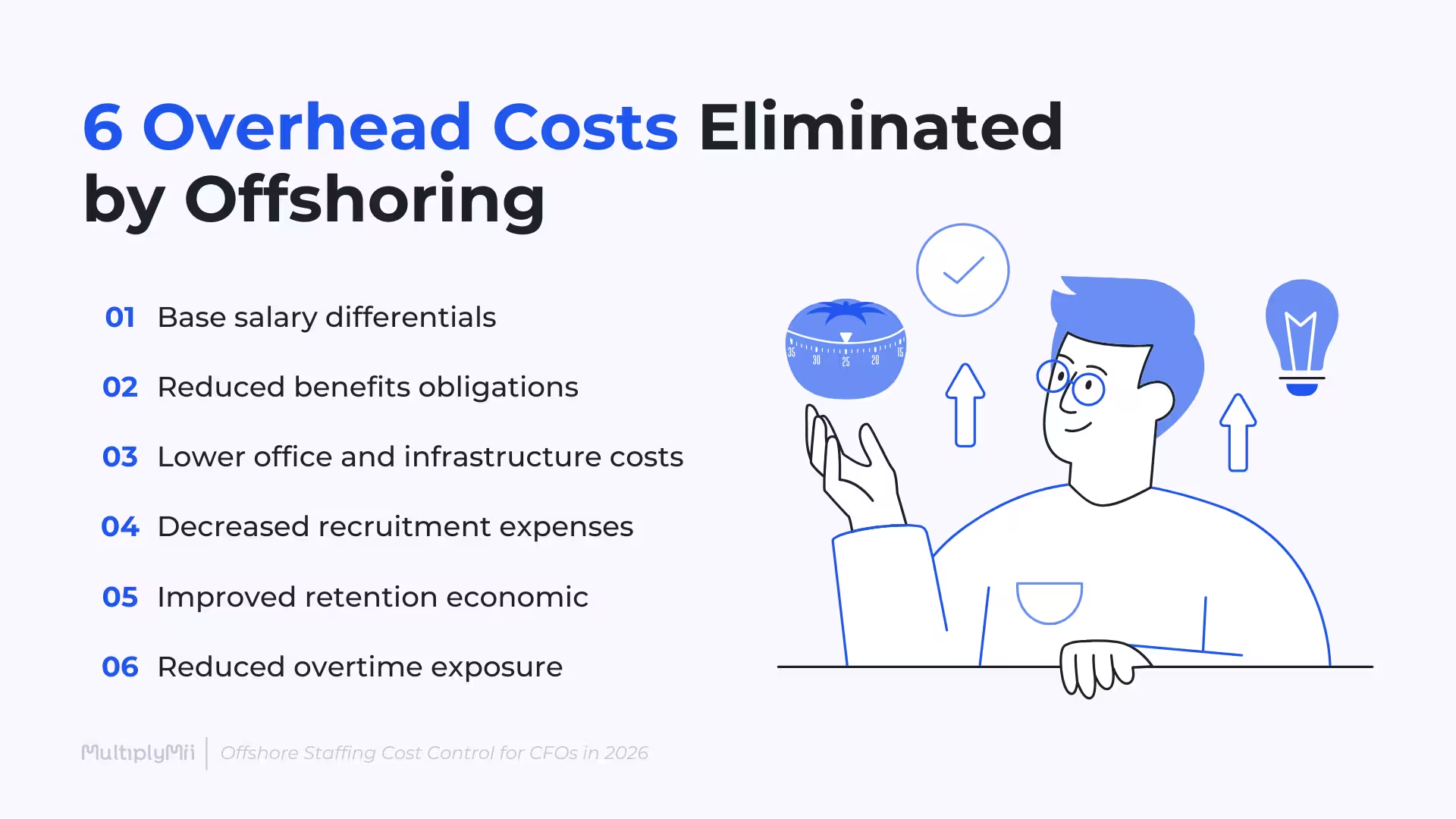
Organizations exploring enterprise staffing solutions are increasingly prioritizing operational efficiency over short-term staffing volume.
The goal is no longer simply “cheaper labor.” The goal is to build a more scalable labor model with measurable ROI.
Building an Offshore Staffing Budget Framework
For finance leaders, successful offshore hiring begins with structured forecasting. When properly forecasted, this strategy ceases to be a mere cost-cutting tactic and becomes a lever for operational growth.
1. Establish fully loaded labor costs
Many organizations underestimate the true cost of local employees because they only evaluate salary.
A fully loaded labor model should include:
- Base salary
- Taxes and statutory obligations
- Healthcare and benefits
- Equipment and software
- Office overhead
- Recruitment costs
- Management overhead
- Retention and replacement costs
Comparing fully loaded local costs against offshore alternatives provides a more accurate framework for evaluating workforce investments.
Companies using the average salary benchmarks in the Philippines often discover that operational savings extend well beyond salary alone. While saving money on basic rates is what makes companies consider hiring Filipino remote talent first, the real financial victory comes from cutting out all the extra, hidden costs of employing someone locally.
2. Build role-based rate cards
Finance teams should stop guessing salaries or negotiating every single job offer, and instead use a fixed, standardized pricing system. The easiest way to do so is to create an internal rate card.
An internal rate card lists specific job titles, experience levels, and skill sets, showing the exact total cost of each role. By using this, finance teams can instantly know how much a new hire will cost, eliminating unexpected expenses and making it easier to plan.
Typical categories you can include for an internal rate card:
- Entry-level operational support
- Mid-level specialists
- Technical experts
- Senior managers
- Strategic leadership support
The benefits this approach creates:
- Forecasting consistency
- Budget transparency
- Better procurement governance
- Improved workforce scalability
More than that, structured rate cards also help avoid uncontrolled hiring expansion across departments.
Productivity KPIs CFOs Should Track
Cost reduction without productivity visibility creates operational risk. When scaling a distributed workforce, finance leaders can’t manage by gut feeling or rely purely on cost-saving metrics.
The most effective offshore staffing models rely on measurable KPIs tied directly to business outcomes.
Here are some recommended KPIs to include:
Organizations managing offshore teams should combine financial KPIs with operational performance metrics to maintain visibility across distributed workforces. This data-driven approach ensures your remote operations remain lean, accountable, and completely aligned with your growth objectives.
Governance Controls for Offshore Workforce Management
Another crucial concern among enterprise finance leaders is governance. Without proper oversight, offshore workforce expansion can create:
- Compliance exposure
- Data security risks
- Inconsistent reporting
- Operational fragmentation
To mitigate these risks, CFOs should implement:
- Standardized onboarding procedures
- Access control policies
- Workforce utilization reporting
- Role-based permissions
- Monthly productivity audits
- Centralized vendor oversight
- Clear escalation frameworks
Governance should be treated as part of the staffing infrastructure itself—not as an afterthought.
Compliance Considerations in 2026
As distributed workforces scale globally, cross-border compliance has become a primary boardroom priority. For finance leaders, expanding into international talent markets introduces a complex web of regulatory obligations that go far beyond simple payroll processing.
Managing a remote workforce requires continuous oversight of the following:
- Local labor laws
- Payroll compliance
- Data privacy regulations
- Contractor classification risks
- Intellectual property protection
This is why many organizations choose structured staffing partners instead of unmanaged freelancer marketplaces.
For example, companies evaluating finance and accounting outsourcing companies often prioritize providers that can manage:
- Payroll administration
- HR compliance
- Benefits management
- Workforce documentation
- Security protocols
Compliance maturity is becoming a major differentiator in enterprise offshore staffing decisions.
Offshore Staffing vs Traditional Outsourcing
Traditional outsourcing typically focuses on basic service delivery through third-party agencies managing massive, disconnected operational pools.
Modern offshore staffing, on the other hand, represents a major paradigm shift.
This difference is critical in the current market: while a standard outsourced model provides short-term tactical relief, a dedicated offshore team serves as a long-term strategy.
Modern offshore staffing differs because:
- Professionals work directly within your systems
- Teams integrate into your workflows
- Communication remains transparent
- Management visibility is retained
- Workforce scalability improves
This model gives finance leaders greater control over:
- Productivity measurement
- Workforce planning
- Cost forecasting
- Resource allocation
The Future of CFO Workforce Planning
In 2026, workforce strategy is increasingly becoming a finance function. Faced with persistent localized talent deficits and escalating market volatility, CFOs have become architects of operational efficiency, making them directly tasked with:
- Optimize labor efficiency
- Improve operational scalability
- Support global hiring flexibility
- Reduce unnecessary overhead
- Protect organizational margins
Organizations that successfully integrate offshore staffing into long-term planning frameworks often gain:
- Faster scaling capability
- Better operational resilience
- Stronger margin protection
- Improved hiring flexibility
As competition for skilled labor intensifies, the offshore workforce strategy is evolving from a cost-saving initiative into a long-term operational advantage.
.avif)
Transform Operational Efficiency Through Strategic Offshore Staffing Services
For modern finance leaders, offshore staffing is a structured workforce strategy designed to improve scalability, operational visibility, and long-term financial efficiency of a business.
Companies implementing well-governed offshore staffing services can achieve significant savings on labor costs while maintaining productivity, compliance, and organizational control.
Unlock this solution with MultiplyMii!
By partnering with us, get to safeguard your margins, standardize your hiring budget, and drive measurable business outcomes!
Book a FREE consultation today to discuss how to strategically scale your business with top Filipino remote talent.

Carla masterminds the long-term relationship strategy at MultiplyMii, ensuring clients unlock the full potential of their offshore investments. Deeply committed to protecting client ROI, she specializes in engineering sustainable, long-term partnerships through proactive communication and data-driven account management.


Your Hiring Cheat Sheet for 2026
Frequently Asked Questions
Offshore hiring (or offshore staffing services) is a strategic workforce solution where businesses hire dedicated remote professionals from cost-optimized global talent markets, such as the Philippines.
The optimal provider depends entirely on an organization's specific operational goals.
For mid-market and enterprise companies requiring structured oversight, MultiplyMii serves as a strategic partner. While unmanaged freelancer marketplaces introduce operational volatility, MultiplyMii provides high-governance staffing solutions that standardize hiring budgets, protect corporate margins, and secure specialized Filipino professionals.
While some platforms operate as unmanaged freelancer marketplaces, MultiplyMii delivers managed offshore staffing services that help businesses safeguard their margins, standardize hiring budgets, and secure top Filipino remote talent.
To achieve maximum cost-effectiveness while scaling your workforce, finance and operational leaders should implement the following structural controls:
- Evaluate total costs of domestic employees (including base salary, payroll taxes, benefits, etc.) to accurately measure the 50–80% savings delivered by offshore staffing services.
- Create an internal, standardized pricing matrix across experience levels to ensure budget transparency and prevent unauthorized headcount expansion.
- Mitigate productivity risks by measuring objective, data-driven financial and operational metrics.
- Mitigate security and regulatory risks by enforcing strict onboarding procedures, role-based access controls, and monthly productivity audits.
- Partner with a trusted remote staffing company that can help you navigate the offshore hiring space
The distinction lies in operational control, integration, and long-term strategy.
Traditional outsourcing or BPO functions as a short-term tactical solution where an isolated, third-party vendor manages disconnected operational pools to deliver basic services. In this model, your business has minimal direct oversight of daily tasks.
Offshore staffing, on the other hand, is a strategy where dedicated remote professionals work directly within your systems. Experts are hired to integrate into your workflows and maintain communication with your local team, providing management visibility and cost forecasting control.