Best Offshore Staffing Services for Mid-Market Companies in 2026


Key Takeaways
- In 2026, leading mid-market companies are abandoning transactional, task-based outsourcing. Success lies in building integrated remote teams that own outcomes, not just checklists.
- The best offshore staffing services go far beyond simple recruitment; they provide a comprehensive talent infrastructure that includes automated onboarding, secure data provisioning, and localized retention support.
- The choice between recruitment-only, full-service staffing, or EOR models should be driven by your internal management bandwidth and the complexity of the roles you intend to scale.
- Top-tier providers neutralize administrative friction by offering unified fringe benefit stipends, allowing talent to manage their health and wellness independently while protecting the client’s operational focus.
What Are Offshore Staffing Services?
Offshore staffing services are end-to-end talent acquisition and operational management frameworks that enable companies to secure, onboard, and retain high-performing remote professionals from offshore markets.
For mid-market companies, offshore staffing is often used to expand operational capacity without relying only on local hiring markets. Businesses may partner with offshore staffing experts like MultiplyMii to hire remote professionals, building out entire functional departments like digital marketing teams, eCommerce managers, or technical support.
Why Do Mid-Market Companies Use Offshore Staffing Services?
Mid-market companies use offshore staffing services to access skilled talent, resolve operational bottlenecks, and scale teams more efficiently.
Mid-market companies use offshore staffing services to solve specific scaling challenges:
- Expand without increasing local overhead too quickly
- Hire specialist roles that are hard to source locally
- Support fast-growing departments
- Reduce operational bottlenecks
- Build distributed teams
- Add capacity across time zones
- Improve customer support coverage
- Strengthen back-office operations
- Scale marketing, ecommerce, finance, or technical functions
To map out a high-leverage hiring sequence, business leaders can book a remote strategy workshop to audit existing team structures, identify high-impact roles, and establish a high-performing offshore staffing blueprint.
What Makes Offshore Staffing Different for Mid-Market Companies?
Offshore staffing is different for mid-market companies because hiring decisions affect larger teams, more complex workflows, stricter processes, and higher performance expectations.
Mid-market companies sit in a delicate middle ground: too large for informal startup hiring, yet lacking enterprise budgets. At this stage, every hiring decision carries systemic weight, where one bad hire can derail cross-functional projects and stall growth.
For mid-market companies to scale smoothly, their offshore strategy must address several critical components:
- Outcome-Based Role Scoping: Defining exactly what the role must accomplish and own before the search begins.
- Data-Driven Salary Benchmarking: Aligning budgets with real-time market data to attract top-tier talent without overpaying.
- Rigorous Candidate Vetting: Assessing not only technical skills but also remote-work readiness and cultural alignment.
- Strategic Interview Support: Equipping your hiring managers with structured evaluation frameworks to identify true high-performers.
- International Compliance & Legal Guidance: Navigating localized labor laws, tax regulations, and contract structures safely.
- Structured Onboarding Frameworks: Ensuring new hires are set up with the training, context, and resources they need to contribute from Day One.
- Manager & Leadership Alignment: Helping your domestic managers effectively lead, communicate, and build trust with a distributed team.
- Clear Performance Metrics: Establishing measurable, outcome-focused KPIs rather than tracking simple activity metrics.
- Proactive Retention Support: Keeping team members engaged, motivated, and aligned with your long-term company culture.
- Reliable Replacement Planning: Securing proactive guarantees and support if a placement needs to be adjusted.
- Standardized Communication Rhythms: Establishing clear asynchronous and synchronous loops to keep teams aligned without micromanagement.
The Best Offshore Staffing Solutions for Mid-Market Companies in 2026
Mid-market expansion demands a hiring strategy that protects quality while optimizing overhead. The following solutions represent the premier offshore staffing models for 2026, built to help mid-sized organizations integrate top-tier global talent into their core operations.
1. Offshore recruitment services
Offshore recruitment services help mid-market companies source, screen, and shortlist remote professionals in another country. This is one of the most common offshore staffing services because it gives businesses access to wider talent pools without managing the entire sourcing process internally.
A strong offshore recruitment service should include:
- Role discovery
- Candidate sourcing
- Resume screening
- Skills assessment
- Communication checks
- Salary alignment
- Shortlisting
- Interview coordination
- Reference checks where appropriate
- Offer support
Best for
Offshore recruitment services are best for mid-market companies that already have internal management, payroll, onboarding, and HR processes but need help finding qualified candidates.
Watch out for
Recruitment-only services may not include post-hire support, payroll, benefits, compliance administration, or retention help. If your company needs more operational support, a fuller-service staffing model may be better.
2. Full-service offshore staffing
Full-service offshore staffing bridges the gap between talent acquisition and long-term workforce management. Beyond recruitment, this model integrates employer-of-record guidance, localized payroll administration, HR compliance, and ongoing performance support.
A full-service staffing solution is engineered for middle-market organizations seeking a structured, low-friction framework to build and sustain remote teams. They help with:
- Targeted candidate sourcing and rigorous vetting
- Employment structure and compliance guidance
- Localized payroll and fringe benefits administration
- Structured onboarding and integration support
- Regular management check-ins and performance alignment
- Talent retention programs and replacement guarantees
- Dedicated client success management
Best for
Full-service staffing is ideal for mid-market leadership teams intent on scaling dedicated, long-term global departments without absorbing the operational and administrative burden internally.
Watch out for
Fee structures within this model vary significantly across providers. Leaders should verify whether proposed service agreements cover base compensation, statutory benefits, payroll processing, replacement coverage, and account management—or if those carry separate fees.
Businesses comparing service models can review client pricing options before choosing a staffing provider.
3. Employer of Record support
An Employer of Record (EOR) support provides the legal and operational infrastructure needed to hire global talent without establishing an onshore legal entity.
By acting as the legal employer of record, the provider assumes local legal liability, handles employment contracts, manages payroll, and administers statutory benefits in compliance with local labor laws.
For mid-market companies scaling into talent markets like the Philippines, an EOR model provides a compliant entry point without the capital expenditure, legal overhead, or delay of setting up a local subsidiary.
Best for
EOR support is ideal for growing companies that have already identified the specific international talent they want to hire and simply require a compliant, turnkey framework to employ them offshore legally.
Watch out for
An EOR is not always the same as a recruitment provider. Some EOR companies handle employment administration but do not source candidates. Others may partner with recruitment firms.
Mid-market companies should confirm whether recruitment, onboarding, and retention support are included.
4. Managed Offshore Staffing
Managed offshore staffing introduces dedicated operational oversight, bridging the gap between direct team management and traditional process outsourcing.
Under this model, the provider supplies dedicated talent while assuming responsibility for functional performance. Rather than placing the burden of daily supervision, quality control, and output tracking on internal managers, the staffing partner provides operational leads who manage workflows, enforce service-level agreements (SLAs), and handle daily reporting.
Best for
Managed staffing is particularly effective for growing organizations expanding standardized, volume-driven functions, such as customer support, eCommerce execution, back-office administration, or bookkeeping, where internal leadership lacks the bandwidth to supervise line-level tasks directly.
Watch out for
Managed staffing may give businesses less direct control over individual team members. Companies should clarify reporting, quality control, ownership, and performance expectations before signing.
5. Flexible Talent Support
Flexible talent support gives organizations rapid access to specialized offshore professionals to handle short-term, seasonal, or overflow capacity needs.
This model enables mid-market companies to scale capacity on demand without immediately absorbing long-term headcount liabilities. Whether addressing seasonal volume surges, clearing operational backlogs, or executing finite projects, flexible support acts as an operational buffer to keep core onshore teams focused on primary growth targets.
Flexible support may be used for:
- Commerce Seasonality: Handling Q4 or promotional sales volume surges
- Customer Care Spikes: Managing temporary increases in support tickets or chat inquiries
- Project Execution: Supporting website migrations, data cleanups, or campaign rollouts
- Operational Backlogs: Resolving finance, accounting, or administrative bottlenecks
- Coverage Gaps: Maintaining output during parental leave or internal recruitment searches
Best for
Flexible talent support is best for companies that need quick capacity without committing to a permanent hire immediately.
Watch out for
Flexible support works best when the scope is clear. If the work requires deep company knowledge or long-term ownership, a permanent offshore hire may be more effective.
Companies with urgent or overflow hiring needs can explore Talent Overflow as a flexible support option.
6. Specialized Functional Hiring
Integrating dedicated global talent within existing operational structures enables organizations to expand departmental capacity, maintain quality standards, and control total cost of workforce.
How Should Mid-Market Companies Compare Offshore Staffing Providers?
Mid-market companies should compare offshore staffing providers by evaluating role specialization, compliance architecture, total cost transparency, onboarding frameworks, and long-term retention SLAs.
Selecting a partner is a strategic operational decision. The ideal staffing provider understands your business outcomes, evaluates candidate readiness against high-level performance metrics, and provides the infrastructure necessary for long-term employee retention and compliance.
Offshore Staffing Provider Comparison Checklist
To review verified client outcomes and see how growing organizations structure high-performing remote teams, explore our client case studies.
What Offshore Roles Should Mid-Market Companies Hire First?
The best initial offshore hires for mid-market companies are high-volume, recurring operational roles that eliminate workflow bottlenecks and reclaim onshore management bandwidth.
When building a global remote team, leadership should prioritize functional positions with clear role boundaries, established software workflows, and measurable KPIs. Sourcing these high-leverage support roles first yields immediate operational capacity, protects corporate margins, and establishes the foundation for scaling larger departmental teams.
Good first offshore hires often include:
- Operations & Executive Support: Operations Coordinators, Executive Assistants, Project Managers, Recruitment Coordinators
- Finance & Accounting: Bookkeepers, Accounts Payable/Receivable Specialists, Financial Analysts
- Customer Experience: Customer Support Specialists, Client Success Coordinators, Helpdesk Agents
- eCommerce & Marketing: eCommerce Operations Specialists, Content Writers, SEO Specialists, Marketing Ops
- Data & Systems: Data Analysts, System Administrators, Process Mapping Specialists
Unsure where global talent will create the most impact on your operations? A remote strategy workshop can help identify which role may create the highest return.
How Much Do Offshore Staffing Services Cost?
The cost of offshore staffing services depends on the role, seniority, country, provider model, salary range, benefits, service fees, and level of support included. Mid-market companies should compare total value, not only the lowest monthly cost.
Costs may vary based on:
- Full-time vs part-time hiring
- Recruitment-only vs full-service staffing
- Contractor vs employee setup
- Role complexity
- Experience level
- Required tools or certifications
- Time zone overlap
- Replacement support
- Payroll and benefits administration
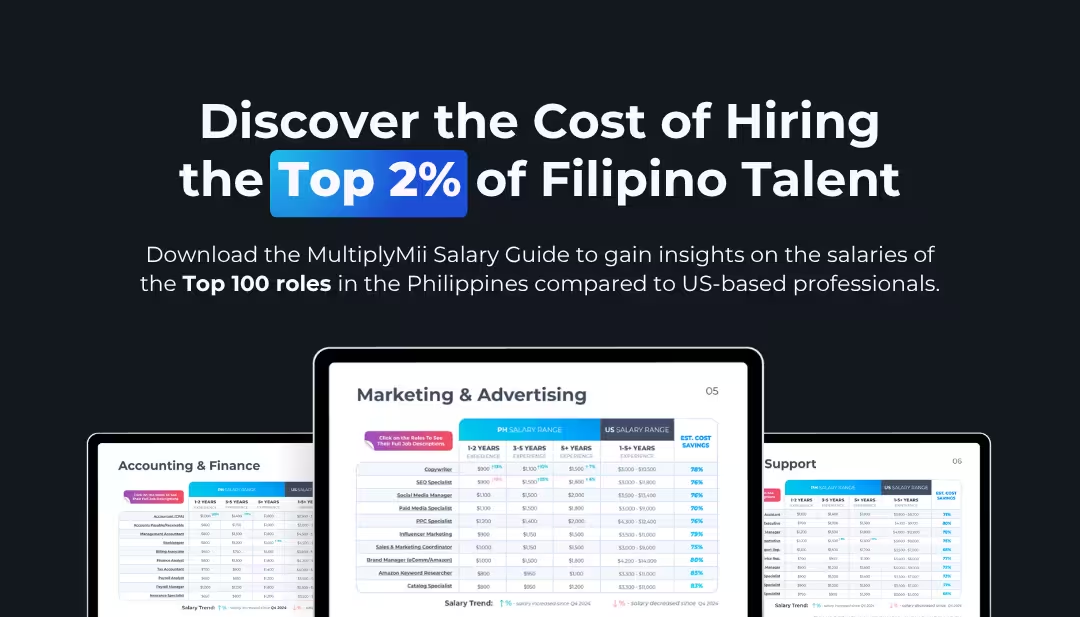
Need accurate, real-time market data to plan your offshore hiring budget?
Download the 2026 Philippines Salary Guide to access current salary benchmarks across specialized industries.
What Are the Risks of Choosing the Wrong Offshore Staffing Service?
Selecting an incompatible offshore staffing partner creates more problems than poor role fit. Selecting a provider strictly on speed or low cost exposes organizations to six critical operational risks:
- Misaligned candidate quality & mismatched skillsets
- High employee turnover & institutional knowledge loss
- Labor compliance & tax liabilities
- Unclear pricing & unforeseen management overhead
- Data security & intellectual property exposure
- Weak onboarding & disjointed team integration
The best way to reduce risk is to define the role, benchmark salary expectations, choose the right hiring model, and ask providers detailed questions before signing.
When Should a Mid-Market Company Use Flexible Offshore Staffing?
A mid-market company should use flexible offshore staffing when workload increases suddenly, internal teams are overloaded, or the business needs temporary support before committing to a permanent hire. Flexible staffing works best when the scope is clear, and the work can be started quickly.
Common use cases include:
- Seasonal eCommerce demand
- Customer support backlogs
- Marketing campaign support
- Finance cleanup projects
- Admin overflow
- Data entry or reporting support
- Product listing updates
- Short-term operations support
Need fast, flexible capacity to bridge an immediate talent gap? Explore how Talent Overflow solutions deliver pre-vetted, on-demand remote support.
What Is the Best Offshore Staffing Model for Mid-Market Companies?
The optimal offshore staffing model depends on your internal bandwidth and how much support your leadership team requires across the hiring, onboarding, and management lifecycle.
There is no universal "best" offshore staffing model. The right approach depends entirely on your internal management capacity and where your organization sits on the operational maturity curve.
While companies with fully staffed HR departments might only need help sourcing candidates, those looking to build long-term, integrated remote teams usually get the best results from a full-service staffing partner or an Employer of Record (EOR) structure.
Choosing the Right Offshore Staffing Service in 2026
Choosing the best offshore staffing service for a mid-market company in 2026 starts with understanding what kind of support the business actually needs.
Some companies only need candidate sourcing. Others need help with onboarding, compliance, retention, payroll coordination, or flexible overflow capacity.
The right service should match your role complexity, budget, and long-term growth plan. And a strong offshore staffing partner, like MultiplyMii, can help you build a team that performs well, communicates clearly, and stays aligned with your business goals.
With over 10 years of experience navigating the space, MultiplyMii has helped multiple businesses in various industries with its remote strategy workshop, resources like the 2026 Philippine salary guide, or a consultation with one of its offshore hiring experts.
Start scaling your business the right way. Connect with MultiplyMii today!

As Head of Operations at Escala, Jas ensures that transitioning into remote staffing is a seamless experience for new partners. She is an expert in workflow optimization, dedicating her days to keeping internal operations lean, agile, and effective.


Your Hiring Cheat Sheet for 2026
Frequently Asked Questions
The optimal offshore staffing service models for mid-market companies include:
- Offshore Recruitment: Sourcing and vetting candidates for companies with established internal HR infrastructures.
- Full-Service Staffing: End-to-end talent acquisition, onboarding, payroll, local compliance, and talent retention.
- Employer of Record (EOR) Support: Turn-key employment legal protection without setting up an offshore entity.
- Managed Offshore Staffing: Hands-on operational oversight, daily workflow management, and KPI/SLA tracking.
- Flexible Talent Support: Immediate capacity for seasonal volume surges, operational backlogs, or finite projects.
- Specialized Functional Hiring: Dedicated department scaling across Finance, Marketing, eCommerce, Customer Support, Operations, Technology, and Executive Support.
Mid-market companies use offshore staffing to expand operational capacity, eliminate workflow bottlenecks, extend service coverage hours, and access specialized global talent pools.
Rather than relying solely on high-cost local hiring markets, mid-market organizations deploy offshore teams to scale core business functions—including finance, operations, marketing, eCommerce, customer experience, and software development—while controlling workforce costs.
No. Offshore staffing is highly effective for mid-market companies. While enterprise corporations often establish costly physical offshore subsidiaries, middle-market businesses leverage offshore staffing partners to access the same top-tier international talent and EOR infrastructure without capital-intensive overhead. This enables growing companies to scale specialized departments, increase execution speed, and compete effectively against larger enterprise rivals.
Offshore staffing costs depend on role complexity, seniority, employment model, and service scope. To ensure long-term retention and avoid hidden costs, mid-market companies should evaluate the total cost of workforce, separating direct talent compensation from provider management fees.
To benchmark competitive, market-validated salary ranges before hiring, download the 2026 Philippines Salary Guide.
The best initial offshore hires are high-volume, recurring operational roles that eliminate workflow bottlenecks and reclaim internal leadership bandwidth. High-impact initial roles include:
- Operations & Executive Support: Operations Coordinators, Executive Assistants, Project Managers.
- Finance & Accounting: Bookkeepers, Accounts Payable/Receivable Specialists, Financial Analysts.
- Customer Experience: Customer Support Specialists, Client Success Coordinators.
- eCommerce & Marketing: eCommerce Specialists, SEO Coordinators, Content Writers, Marketing Operations.
- Data & Systems: Data Analysts, System Administrators, Process Specialists.